A working link building stack needs one tool per job, not twenty: a backlink index to find opportunities (Ahrefs or Semrush), an email finder (Hunter or Snov.io), an outreach CRM (BuzzStream), a journalist-request service for earned links (HARO, Qwoted), a rank tracker, and a link checker that tells you when a placed link disappears. Below is what each tool does, what it costs as of November 2026 (from each vendor's pricing page), and where we think the money is worth it.
Link building tools by category
Many tools do several things. We list each one under the job it does best.
Backlink research and site assessment
This is the tool you will use every day: to see who links to your competitors, to judge whether a site is worth a link, and to check your own profile. Pick one. Paying for two indexes is only worth it at agency scale.
| Tool | Best at | Price | Free option |
|---|---|---|---|
| Ahrefs | Link index, Link Intersect, Domain Rating (DR) | Starter $29/mo; Lite $129/mo; Standard $249/mo; Advanced $449/mo | Ahrefs Free for your verified sites; free backlink checker |
| Semrush | All-in-one suite, Backlink Gap, Authority Score | SEO $139/mo; Starter $199/mo; Pro+ $299/mo | Free plan, 10 reports a day; 7-day trial |
| Majestic | Trust Flow and Citation Flow | Lite $49.99/mo; Pro: $99.99/mo; API $399.99/mo | Free backlink checker; 7-day money-back on Lite and Pro |
| Moz Pro | Domain Authority, Spam Score | Starter $49/mo; Standard $99/mo; Medium $179/mo | 10 Link Explorer queries a month |
Every index has its own score: DR in Ahrefs, Authority Score in Semrush, Trust Flow in Majestic, Domain Authority in Moz. They all measure link strength on a 0–100 scale, and they can all be inflated with spam. That is why we never judge a site on authority alone. Organic traffic and its trend matter more: a site with DR 50 and almost no visitors from Google is usually selling links to anyone, and the link is worth little.
Semrush no longer lists its old Pro, Guru and Business plans; if a guide quotes them, its prices are out of date.
Getting earned links: journalist requests
Journalist-request services send you questions from reporters looking for expert sources. Answer fast and well, and some answers turn into quotes with a link from news and trade media. It costs time, not money, and the hit rate is low, but the links are the kind you can't buy.
| Tool | How it works | Price |
|---|---|---|
| HARO | Daily email with media queries; now run by Featured | Free for sources |
| Qwoted | Platform where journalists post requests and you pitch | Basic free (2 pitches a month); Pro $149.99/mo (35 pitches) |
What works: answer within the first hours, give one specific, quotable point with a number or an example, and only pitch where you have real expertise. Generic AI-written answers get ignored.
When you'd rather buy the placement than earn it, that is what we do at SEO G.O.A.T.: we place articles with your link on real sites with real organic traffic, from $199 per link at DR 30+. See guest posts and niche edits.
Rank tracking and reporting
Links can take weeks to show an effect, so you need a way to see whether the pages you build links to move. A rank tracker does that. Most backlink suites include one, so buy a separate tracker only if you track many keywords or need client reports.
| Tool | Best at | Price | Free option |
|---|---|---|---|
| SE Ranking | Daily rank tracking plus backlink monitoring for agencies | Core $129/mo; Growth $279/mo | 14-day trial, no card |
| SpySERP | Cheap, pure rank tracking | Pro from $9/mo (5,000 checks) | Free plan; 7-day trial (card required) |
| Serpstat | Keyword and competitor research with rank tracking | Individual $50/mo; Team $100/mo; Agency $410/mo | 7-day trial ($1 card verification) |
| AgencyAnalytics | Client reporting dashboards | $20 per client per month, billed annually; rank tracker add-on extra | 14-day trial, no card |
Prospecting and outreach
Outreach is where link building gets expensive: finding the right person at each site, writing to them, following up, and keeping track of hundreds of conversations. Two kinds of tools help.
Email finders take a domain and return the likely address of an editor or owner, with a confidence score:
| Tool | Price | Free option |
|---|---|---|
| Hunter | Starter $49/mo (2,000 credits); Growth $149/mo (10,000); Scale $299/mo (25,000) | Free plan, 50 credits a month |
| Snov.io | Starter $39/mo (1,000 credits); Pro S $99/mo (5,000); Ultra $738/mo (100,000) | Free trial plan, 50 credits, renews monthly |
Both also send email sequences, which is enough for small campaigns. Credits don't roll over on Hunter, so buy for the volume you actually send.
Outreach CRMs keep every prospect, email and deal in one place, so two people never pitch the same site and nobody forgets a follow-up:
| Tool | Price | Notes |
|---|---|---|
| BuzzStream | Starter $49/mo (1 user, 500 contacts); Growth $174/mo (3 users); Professional $424/mo (6 users); custom from $999/mo | Free trial. Includes link monitoring (1,000 links on Starter). A $19/mo single-user plan also exists. |
Our advice: start with an email finder's built-in sequences. Move to a CRM once more than one person does outreach or you have more than a few hundred active prospects.
Email deliverability and templates
Outreach that lands in spam is wasted. Test before you send a campaign, and keep replies fast with templates.
| Tool | What it does | Price |
|---|---|---|
| Mail-Tester | Send a test email, get a spam score; free SPF, DKIM and DMARC checks | Occasional tests free in the web interface; packs from $5 for 10 tests; subscriptions from $10/mo for 50 tests |
| Briskine | Email reply templates you insert with shortcuts | Free up to 30 templates; Premium $7 per person per month |
Deliverability is mostly setup, not copy: send outreach from a separate domain, authenticate it (SPF, DKIM, DMARC), warm it up, and keep daily volume modest.
Link monitoring and other useful tools
Once links go live, someone has to check they stay live, dofollow and unchanged. Links get removed or edited more often than people expect.
- LinkChecker.pro checks your backlinks daily, checks whether the linking pages are indexed and alerts you when a link is lost. From $25/mo for 400 links; free Chrome extension.
- Linkody checks links once a day and finds new links to you and competitors. From $14.90/mo for 500 links, 30-day free trial.
- Google Search Console is free and shows a sample of the sites linking to you as Google sees them. Not a monitor, but the baseline every site should have.
- MozBar shows Domain Authority and other metrics as you browse; a free Moz account gives limited access.
We compare these and four more in 8 best backlink monitoring tools.
How we build links at SEO G.O.A.T., step by step
Link building at scale is a pipeline: find sites, vet them, find the contact, pitch, negotiate, publish, monitor. Here is how each step works in our blogger outreach, and which tools fit it if you do it yourself. If you'd rather buy placements than run outreach, compare the link building marketplaces.
Finding sites
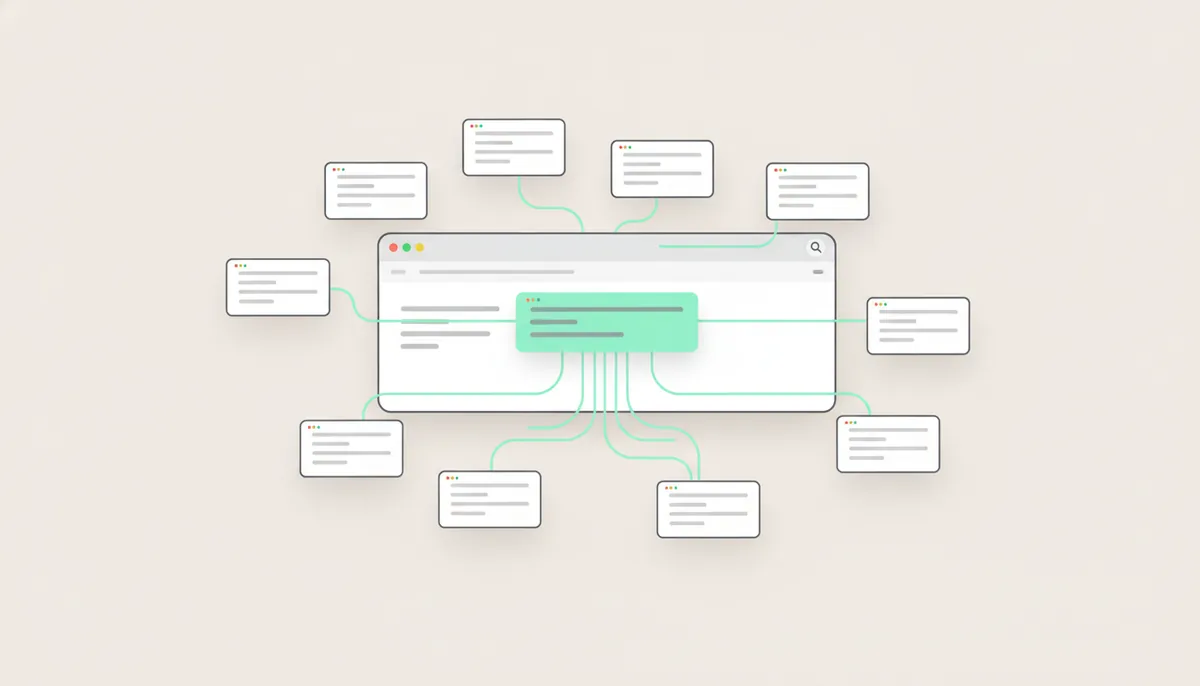
The fastest list of candidate sites is the link profiles of the pages already ranking for your keywords. In Ahrefs, Link Intersect shows sites that link to several competitors but not to you, and filtering for followed links and real organic traffic removes most of the noise. Semrush's Backlink Gap does the same. The full walkthrough is in how to find competitor backlinks, or Link Scout does it for free and sorts the result into links you can get free, ones that take paid placement, and likely link farms.
Vetting each site
Getting a link is easy. Getting one worth having is the work. Every site that reaches our list meets its tier at the time of order: DR, real organic traffic and topic, and it is at least a year old. On top of that, we look at:
- Traffic trend, not just today's number. We skip sites whose organic traffic collapsed in the last year.
- Where the traffic comes from. A US business wants a site read in the US, not one whose visitors come from elsewhere.
- Outbound links. A site that links to casinos, loans and essay mills in every post sells to anyone.
- Who links to the site. Authority built on spam links is fake authority.
- Which pages get the traffic. If one old post brings all the visits and the rest of the site gets none, a new article won't share in it.
- Topic fit. The site and the article should make sense for your business.
Any of the backlink tools above gives you these numbers. Reading them well is what takes practice.
Finding the contact
Check "Write for us," "Advertise," "About" and "Contact" pages first. For anything at volume, an email finder like Hunter or Snov.io saves hours, and running a domain through both finds more addresses than either alone.
Outreach
Short, specific emails work: who you are, the article idea for their audience, and what you're offering. Test a sample with Mail-Tester before a campaign, send from a warmed-up domain that isn't your main one, and follow up once.
Negotiation, publishing and monitoring
Then come price, topic and article requirements. Templates (Briskine or your CRM's own) keep replies fast. We prepare an article of 800+ words for each site, with one anchor and one URL.
After publishing, the link has to be watched. For the links we place, every one is checked daily, live, dofollow and unchanged, with email alerts, and the live URL is in your dashboard. If a link is removed or set to nofollow within 12 months, we replace it free. If you build links yourself, a link checker from the list above does the same job.
For the strategy behind the tools, see our best link building strategies and how to get backlinks.
FAQ
What is the best link building tool?
A backlink index: Ahrefs or Semrush. It's the one tool you use in every step, from finding sites to checking your results. Everything else is optional until you do outreach at volume.
Can you build links with free tools only?
For a small site, yes: Semrush's free plan, Ahrefs Free for your own site, Moz's free Link Explorer queries, Hunter's free credits, HARO and Search Console. You'll hit limits quickly once you research many competitors.
Do I need outreach software?
Not at first. An email finder with built-in sequences covers one person sending a few hundred emails a month. A CRM like BuzzStream pays off when a team shares prospects.